
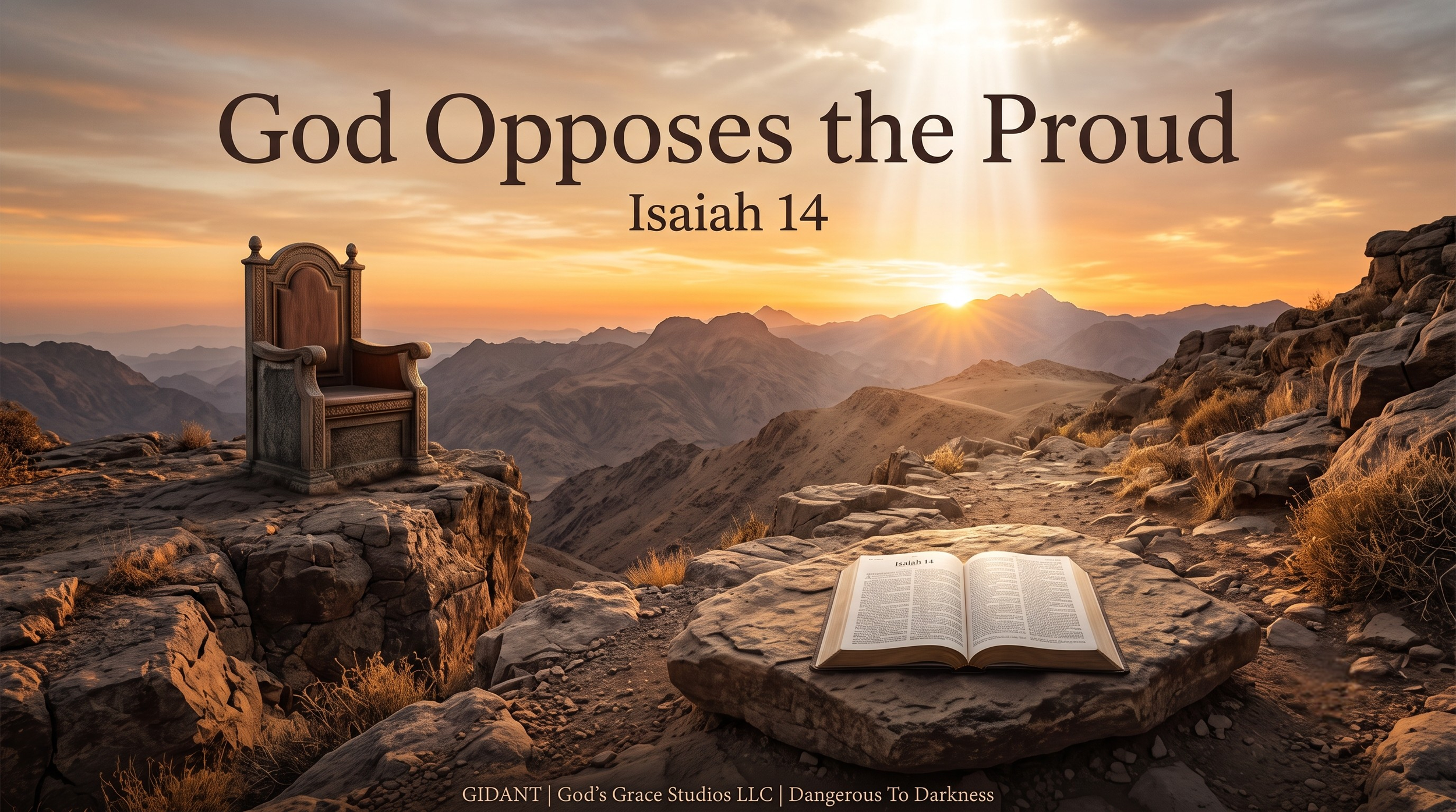
Isaiah Day 14: The Danger of Pride
Verses Used
Isaiah 14 (NLT)
Proverbs 16:18 (NLT)
Philippians 2:5–11 (NLT)
James 4:6–10 (NLT)
Key Verse
Isaiah 14:13–14 (NLT)
"For you said to yourself, 'I will ascend to heaven and set my throne above God's stars. I will preside on the mountain of the gods far away in the north. I will climb to the highest heavens and be like the Most High.'"
Chapter Overview
Isaiah 14 continues God's prophecy concerning Babylon, but it begins with a message of hope for God's people.
One day, Israel would be restored.
Their suffering would not last forever.
The empire that oppressed them would itself fall under God's judgment.
Isaiah then presents a poetic "taunt" against the king of Babylon.
The ruler who once terrified nations is now powerless.
His pride has been shattered.
His glory has faded.
The one who believed himself untouchable now lies humbled in the grave.
As the chapter continues, the description becomes even more striking.
The king declares his desire to ascend above the heavens and make himself like the Most High.
Because of this language, many Christians understand these verses to reflect not only the pride of Babylon's ruler but also the original rebellion of Satan, whose desire was to exalt himself above God.
Whether Isaiah is speaking only of the king of Babylon or using him as a picture of a greater spiritual rebellion, the message remains the same.
Pride always ends in humiliation.
The chapter concludes by reminding us that God's plans cannot be overturned.
What He establishes will stand.
What He opposes will ultimately fall.
What It Meant Then
For Isaiah's original audience, this prophecy offered tremendous hope.
Babylon would one day become the nation that conquered Jerusalem and carried many of God's people into exile.
To those living through that suffering, Babylon would appear invincible.
But Isaiah declared that its power was only temporary.
The mighty king who believed he ruled the world would eventually face the judgment of God.
The poetic language throughout the chapter highlights the arrogance of a ruler who saw himself as untouchable.
His downfall would become a warning to every nation that believed its strength placed it above the Lord.
Many believers also recognize that this passage echoes the deeper spiritual reality behind human pride.
Throughout Scripture, Satan is portrayed as one who rebelled against God and sought glory for himself.
While Isaiah's immediate focus remains the king of Babylon, the language reminds us that every form of pride ultimately reflects the same desire—to place ourselves above God.
For Isaiah's audience, the lesson was clear.
No king.
No empire.
No spiritual power.
No one can successfully exalt themselves against the Lord.
God alone is worthy of the highest place.
What It Means Today
Isaiah 14 reminds us that pride is far more dangerous than we often realize.
We usually think of pride as arrogance or someone constantly bragging about themselves.
But pride can be much quieter than that.
It can sound like...
"I know better than God."
"I don't need His help."
"I'll live life my own way."
At its core, pride is putting ourselves where only God belongs.
That's exactly what we see in Isaiah 14.
The king wanted more than power.
He wanted God's place.
While most of us would never say those words out loud, our actions can sometimes tell the same story.
Every time we choose our will over God's...
Every time we refuse to forgive...
Every time we depend more on ourselves than on Him...
Pride quietly takes root in our hearts.
The good news is that God doesn't expose pride to shame us.
He exposes it so He can heal us.
James tells us that "God opposes the proud but gives grace to the humble."
That's not because God enjoys resisting people.
It's because pride keeps us from receiving the very grace He wants to give.
Humility opens our hearts to His forgiveness, His wisdom, and His strength.
Isaiah 14 also reminds us that no matter how powerful evil may appear, it will never triumph over God.
Human pride may rise.
Evil may seem to flourish for a season.
But God always has the final word.
That truth gives us confidence to live with humility, knowing we don't have to prove ourselves or fight for our own glory.
Our lives are safest when they point to His.
See Jesus Here
Isaiah 14 paints a picture of someone who sought to exalt himself above God.
Jesus did exactly the opposite.
Philippians 2 tells us that although Jesus is fully God, He willingly humbled Himself.
He didn't cling to His position.
He took on the form of a servant.
He entered our broken world as a baby.
He lived a life of perfect obedience.
He humbled Himself even to death on a cross.
The contrast couldn't be greater.
The proud seek to lift themselves higher.
Jesus willingly lowered Himself to lift us up.
Because of His humility and obedience, God highly exalted Him and gave Him the name above every name.
Every knee will bow.
Every tongue will confess that Jesus Christ is Lord.
Isaiah 14 warns us about the path of pride.
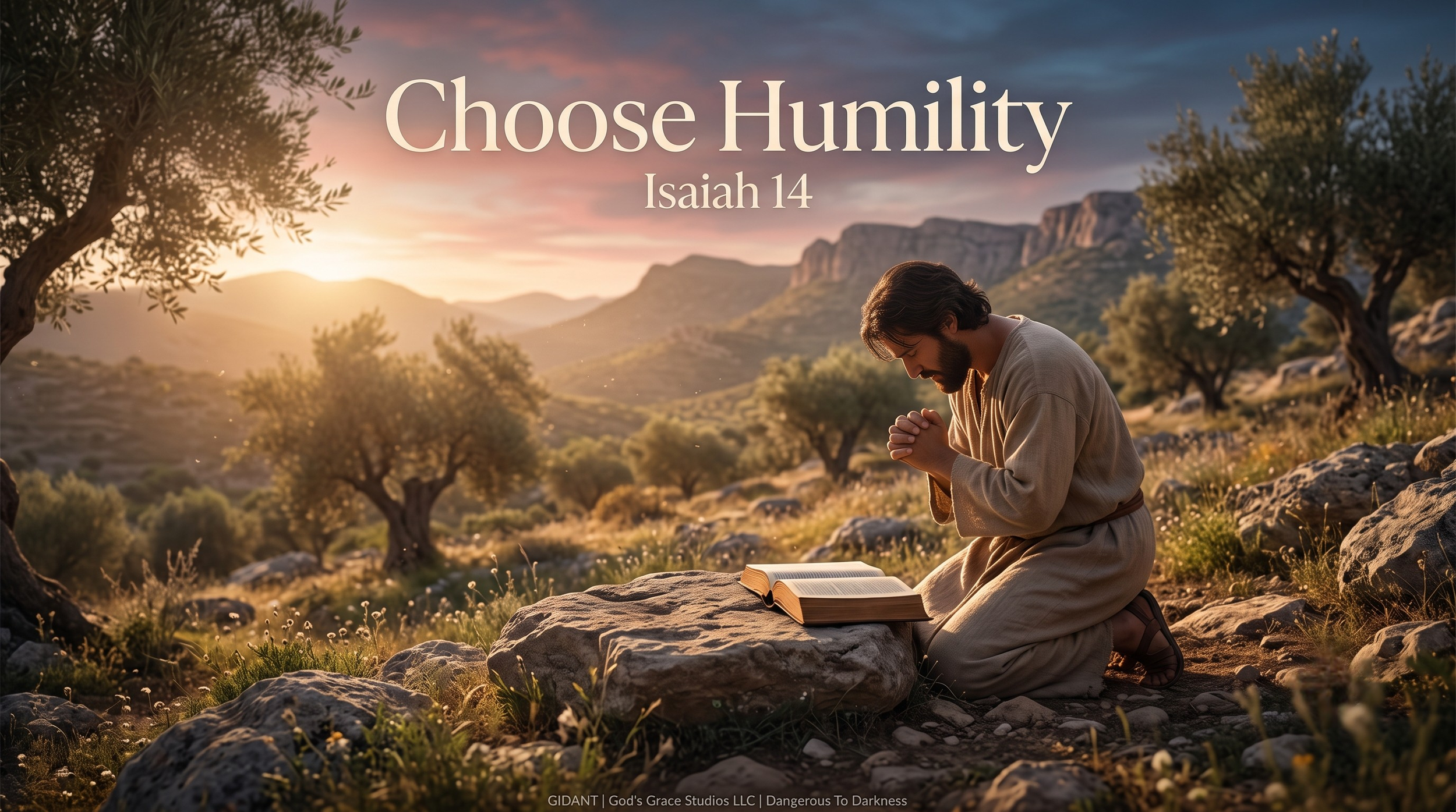
Jesus shows us the path of humility.
One leads to destruction.
The other leads to life.
When we follow Christ, we're invited to lay down our pride, trust His leadership, and discover the freedom that comes from living for God's glory instead of our own.
Character of God
God Gives Grace to the Humble
One of the beautiful truths throughout Scripture is that God delights in showing grace to humble hearts.
He isn't impressed by status, wealth, influence, or human achievement.
He looks at the heart.
Those who humble themselves before Him find forgiveness instead of condemnation.
Mercy instead of rejection.
Strength instead of striving.
God doesn't ask us to become impressive before coming to Him.
He asks us to come honestly.
When we acknowledge our need for Him, we discover that His grace is more than enough.
The Lie vs. The Truth
The Lie
"I'll find fulfillment by putting myself first."
The world constantly tells us that greatness comes from self-promotion, self-reliance, and making a name for ourselves.
Pride promises satisfaction.
But it always leaves us empty.
The Truth
True greatness is found in surrendering our lives to God.
Jesus showed us that humility isn't weakness.
It's strength under God's authority.
The more we seek God's glory instead of our own, the more we become the people He created us to be.
Did You Notice?
Throughout Isaiah 14, the repeated phrase is...
"I will..."
"I will ascend."
"I will raise my throne."
"I will be like the Most High."
Pride constantly focuses on self.
Now compare that to Jesus in the Garden of Gethsemane.
Instead of saying,
"My will be done,"
Jesus prayed,
"Not my will, but Yours be done."
Those two attitudes reveal two completely different paths.
One says,
"I want my glory."
The other says,
"Father, I want Your glory."
Every day, we choose which attitude will shape our lives.
May our hearts echo the humility of Christ instead of the pride that led to Babylon's downfall.
Main Takeaway
Pride tries to take God's place. Humility trusts God to take His rightful place.
Isaiah 14 reminds us that pride is at the heart of every rebellion against God. It convinces us that we know better, deserve more, or don't need His guidance. But God lovingly calls us to a better way—the way of humility. When we surrender our lives to Him, we discover that true greatness isn't found in lifting ourselves up. It's found in walking closely with the One who deserves all the glory.
Reflection Questions
Is there an area of my life where pride is keeping me from fully trusting God?
Am I seeking recognition for myself, or am I seeking to bring glory to Jesus?
What would humility look like in one relationship or situation I'm facing this week?
Action Step
Today, ask God to search your heart.
Take a few quiet moments and honestly pray:
"Lord, show me any pride that has taken root in my life."
As He brings something to your mind, don't defend it or explain it away.
Simply confess it to Him.
Then choose one practical way to practice humility today.
It might be apologizing to someone.
Serving without expecting recognition.
Listening instead of always speaking.
Giving God credit for something good in your life.
Or simply thanking Him for His grace.
Remember this:
Humility isn't thinking less of yourself.
It's thinking of yourself less and thinking of God more.
The more our hearts are filled with His greatness, the less room there is for pride.
Prayer
Heavenly Father,
Thank You for reminding me that You alone are worthy of all honor, glory, and praise. Forgive me for the times pride has quietly taken root in my heart. Too often I've wanted things my way instead of Yours, trusted my own wisdom instead of seeking Yours, or looked for recognition instead of giving You the glory.
Thank You for showing me a better way through Jesus Christ. Thank You that He chose humility, obedience, and sacrificial love so that I could be forgiven and brought into Your family. Help me follow His example every day.
Lord, teach me to walk humbly with You. Give me a heart that is quick to repent, eager to serve, and willing to put others before myself. Help me remember that every good thing I have comes from Your hand and that my greatest purpose is to glorify You.
Protect me from the subtle lies of pride, and fill me instead with the joy and freedom that come from trusting You completely.
As I continue this journey through Isaiah, help me grow in humility, deepen my love for You, and become more like Jesus every day.
In Jesus' name,
Amen.
📚 Read More Devotionals → Click Here
🐴 Enjoy Brother Deacon Comics → Click Here
📖 Need a Bible?
Read online or download the free Bible app. → Click Here
🛍️ Support God's Grace Studios
Every purchase helps support our ministry and allows us to continue creating devotionals, comics, Christian apparel, woodworking projects, and encouraging content.
Browse Our Products → Click Here
🎨 Custom Orders & Free Gifts
Looking for a custom gift, sign, woodworking project, or apparel?
Contact Us → Click Here
Don't miss out on free content!
Subscribe to receive:
📖 Daily Devotionals
🐴 Brother Deacon Comics
🎁 Promotions & Special Offers
📱 FREE Monthly Phone Wallpapers
Subscribe Here → Click Here
